Classes / Training-Join Us !

IIf you would like to become a Paws for Healing volunteer team, please check below for the 2007-2008 class schedule. Then download the application, print and fill it out and mail all forms back to us. (Our mailing address is clearly marked on the forms.) Also enclose a check for $50 to cover your tuition, canine evaluation and insurance coverage for one year. (Certification is renewable each year for $25 to cover insurance fees.)

Applications must be received at least one week before the class begins. We encourage you to sign up as early as possible as class size is limited and our trainings quickly fill. Your check will reserve your place, but should it arrive after the class fills, we will add you and your canine to our waiting list for the next class.

If you are unable to download the application, please call 707.258.3486, leave your name and address (speak slowly), and one will be mailed to you.

Training Seminars
March 8, 2008
May 3, 2008
September 13, 2008
November 1, 2008
March 15, 2008
May 10, 2008
September 20, 2008
November 8, 2008

If you are interested in volunteering for Paws for Healing without a dog, please email or call our hotline so that one of our board members can speak with you. We are looking for a few good people who can help us on special projects or on a regular basis:
  • Would you like to help once a year on a special project, such as our Annual Appreciation Tea, Santa Paws, or the 2009 Calendar? or
  • Could you spend a few hours every other month helping at a training or with our monthly mailings? or,
  • Do you have a talent for crafts and would like to donate some of your time and wares for our Santa Paws Holiday Gift Sale?
Please don’t hesitate to call or email if you would like to help Paws for Healing in some capacity even though you don’t have a canine.

How You Become a Certified PFH Volunteer--Five Steps to Completion

Step 1: Canine-Handler Evaluation and Training Sessions

Training Classes

Training is divided into two sessions. The first session is devoted to the canine-handler evaluation and to learning about how to safely and effectively incorporate your pet into healthcare and educational settings. The second focuses on the many human issues related to canine-assisted therapy, including volunteer rights and responsibilities, healthcare and student populations, and infection, safety and site protocols. During this session, volunteers will choose a site and be assigned a mentor.

Canine-Handler Evaluation
The first stage of certification is an evaluation of dog and handler for appropriate temperament and handling skills. Basic obedience is required, as well as passing an evaluation that includes reactions to:
    • Friendly stranger
    • Food on the floor
    • Negotiating tight spaces
    • Unexpected touching of paws, head, tail
    • Wheelchair & hospital apparatus
    • Loud noise
    • Odd stranger
The evaluation simulates what might happen in a health care or educational setting and tests the confidence of the dog in strange surroundings. Secondly, the handlers are evaluated for basic control and common sense in the same kinds of situations. If a dog or handler needs to reinforce their skills, PFH offers obedience and specialized classes during the year.

For some specialized facilities, such as Napa State Hospital or children’s rehabilitation units, a Canine Good Citizenship certification is also required.


Step 2: Site Selection
Health Care and Educational Facilities


During the second training session, you will choose a facility or program where volunteers are needed and that matches your dog’s abilities.

Health care facilities include
  • Assisted living (rest homes or convalescent centers)
  • Memory care (Alzheimer’s or dementia units)
  • Mental health (hospitals, county facilities, private care)
  • Hospitals (which includes cancer units, pediatrics, ICU, rehabilitation and transitional care, post-op care, cardiac care, waiting rooms)
  • Adult day-care programs
  • Physical therapy programs
  • Hospice venues

Educational facilities include
  • Special education classrooms
  • Adult special education programs
  • Public libraries
  • Primary and elementary school reading programs.

  • You will receive a facility list at the second session.
Step 3: Fulfillment of Site Requirements

Each facility and program has its own requirements that potential volunteers, including PFH teams, must honor. Hospitals, require TB tests and an orientation meeting; programs in which volunteers work with children or with veterans require finger-printing and background checks. Other sites ask for personal interviews or for letters of recommendation. Some sites also have additional training prerequisites for canines, specifically a Canine Good Citizenship rating (“CGC”).

Before you become a PFH certified team, you must fulfill a site’s requirements before you can be mentored. Please note, however, that some larger sites have more complicated requirements and it may take up to two months to schedule and complete an orientation for PFH teams before you may be mentored.

Step 4: Mentoring

PFH wants all our volunteer teams to feel confident and appreciated; that is the reason for our mentoring program. All new human volunteers visit their prospective site with an experienced PFH team in order to
  • orient themselves to the facility;
  • meet facility staff and arrange a schedule;
  • watch the interaction between experienced therapy canines and patients, clients or students.
The first mentoring session is done without the newly certified canine. A second mentoring is scheduled for the new team, including canine, in order to assess the volunteer’s
  • interaction with patients/clients
  • awareness of canine’s interactions;
  • awareness of canine’s needs and reactions to patients/clients.
Once you are mentored, we ask that you commit to visiting the facility twice a month at a time agreed on by you and the staff representative.

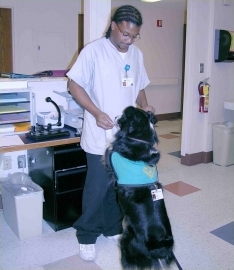
Step 5: Receipt of PFH Badges and Canine Uniforms

Only after a team has successfully completed all the requirements listed below will badges and canine uniforms be sent to new team members:
  • training and evaluation;
  • facility requirements;
  • two mentoring sessions.
At any stage of becoming a fully-certified PFH volunteer team, we have volunteer staff and board members who are willing to help you. Please do not hesitate to call our hotline or email PFH should you have questions or concerns about volunteering, the facility or its regulations, or about other PFH programs.

Tuition Assistance
PFH can offer a grant for all or part of the training fees to perspective volunteers who are on a limited or fixed income, or who are students or in the military. If you would like to apply, please send a letter to:

Board of Directors
Paws for Healing, Inc.
1370 Trancas Street, PMB127
Napa, CA 94558

In the letter, briefly describe:

  1. Why you and your canine would like to volunteer.
  2. What kind of health care or educational facility you are interested in.
  3. What amount of tuition assistance you are requesting.
You will be notified within 2 to 4 weeks after submission of your letter if your request is granted.

Upcoming Classes / Training / Events
Unless otherwise indicated, all events and training will take place at:


To attend training seminars, please download, complete, and submit the following application

Training Seminars
March 8, 2008
May 3, 2008
September 13, 2008
November 1, 2008
March 15, 2008
May 10, 2008
September 20, 2008
November 8, 2008
CGC Training Future dates to be determined depending on interest. To attend the CGC Evaluation, please download, complete, and submit the application
Obedience Training (start dates with training to be held on each Saturday for 8 weeks) October 6, 2007
To attend the Obedience training, please download, complete, and submit the application
Tea February 23, 2008